Abstract
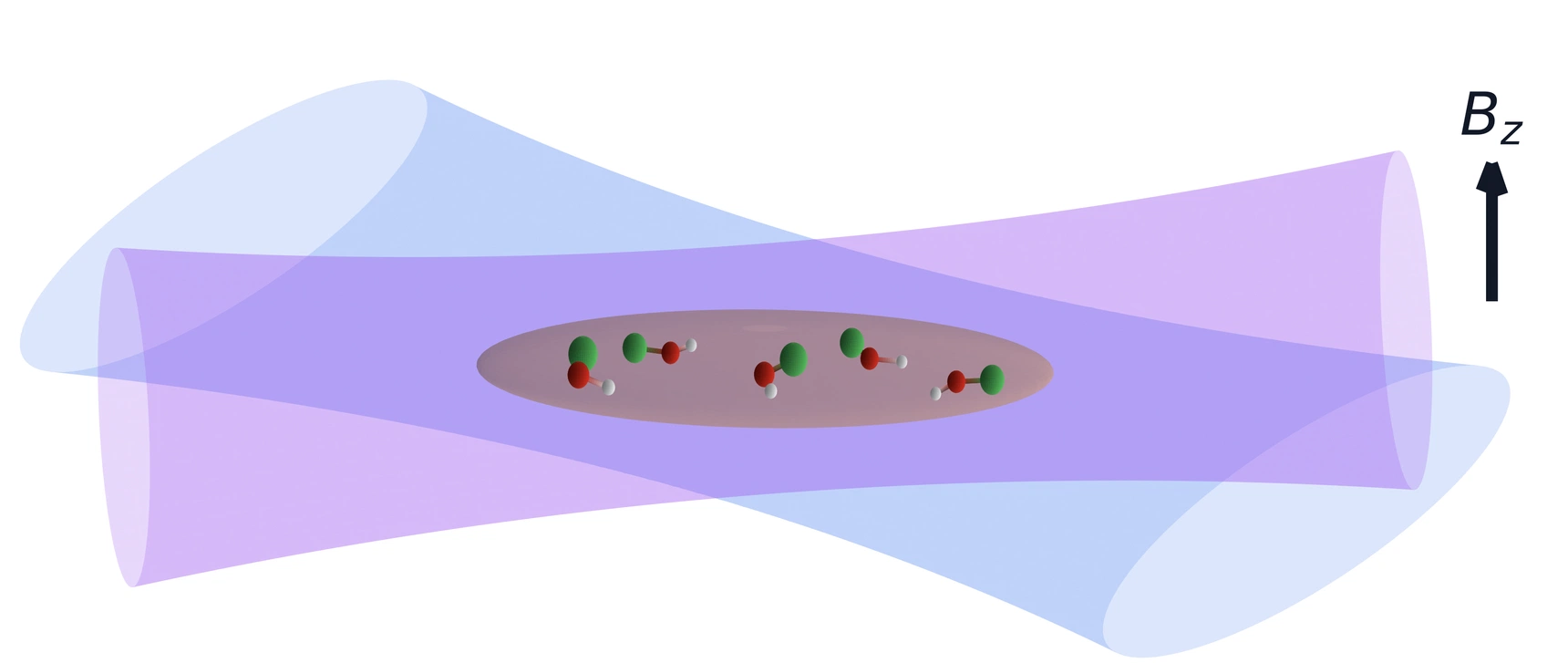
Precision measurements exploit internal molecular structure to search for physics beyond the Standard Model. Reaching the entanglement-enhanced regime requires preparing and preserving correlated molecular states within the same manifold used for sensing. Parity-doublet states are central to proposals for precision measurements with polyatomic molecules because they enable large molecular polarization for enhanced sensitivity, and provide internal state co-magnetometry to suppress systematic errors. Here we report the observation and control of resonant dipolar exchange interactions in a parity-doublet sensing manifold of ultracold polyatomic molecules. Using laser-cooled CaOH molecules in a crossed optical dipole trap, we encode a pseudospin in the ℓ-type parity-doublet states and observe two complementary signatures of interactions: a density-dependent Ramsey contrast decay and a spin-projection-dependent mean-field precession whose sign reverses with the initialized population imbalance. Both observables are well described by a common discrete truncated Wigner model using independently calibrated experimental parameters. We further Floquet-engineer the interaction anisotropy and observe suppressed many-body dephasing near the SU(2)-symmetric Heisenberg point, identifying a protected regime relevant for spin squeezing and precision measurement with dense molecular ensembles. Our results establish parity-doublets as a coherent, interacting, and programmable molecular degree of freedom, connecting the polyatomic precision-measurement platform to dipolar many-body physics and opening a route to entanglement-enhanced tests of fundamental physics.